Data Marketing vs Digital Marketing – Which is Better in 2026?
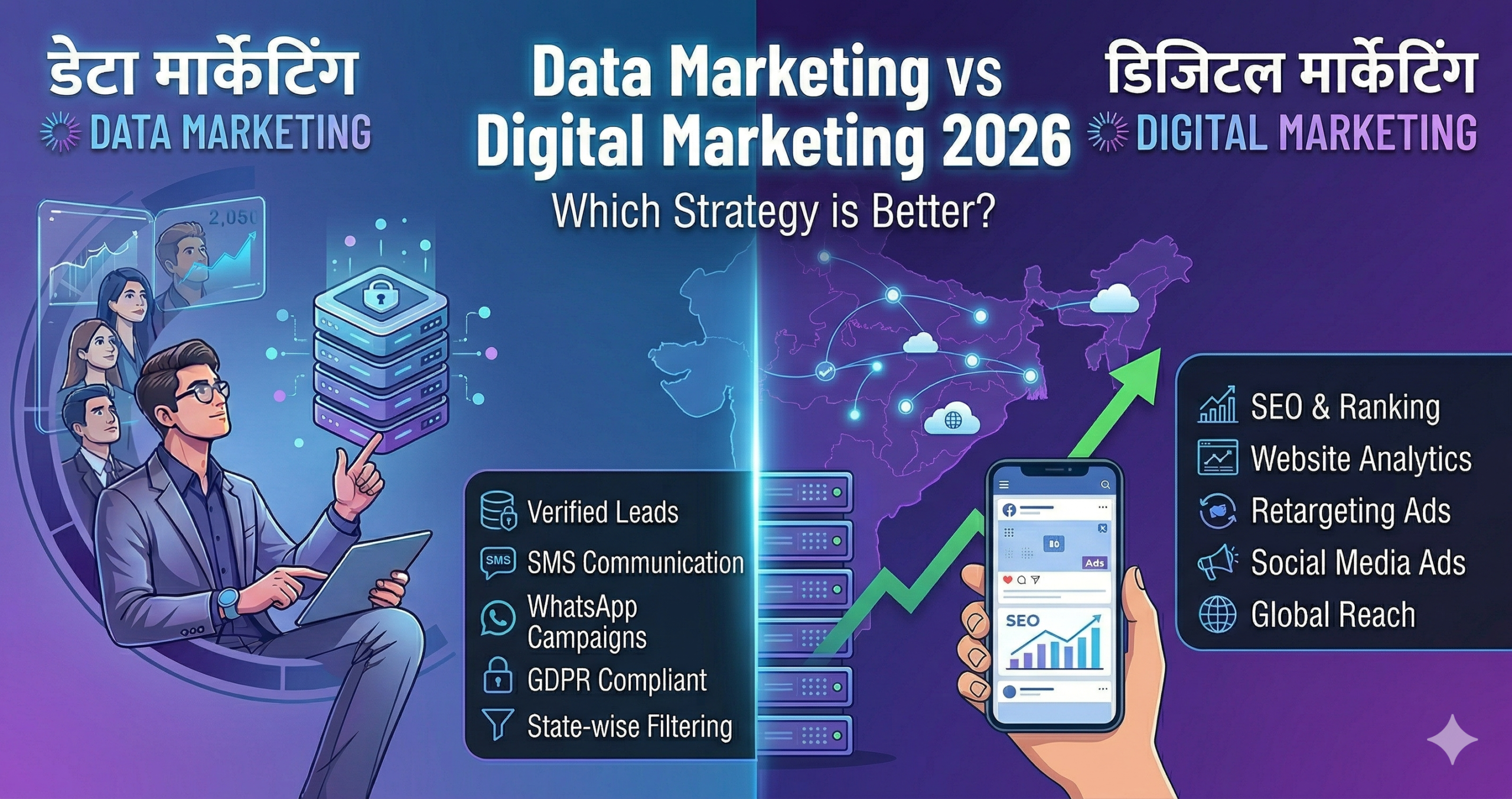
Marketing in 2026 has evolved significantly with the rise of data-driven strategies and advanced digital platforms. Businesses today are often confused between Data Marketing and Digital Marketing, as both play crucial roles in customer acquisition and growth.
While these approaches may seem similar, they operate differently and serve distinct purposes. Understanding the difference between them can help businesses choose the right strategy—or combination—for maximum results.
This guide provides a complete comparison of Data Marketing vs Digital Marketing and helps you decide which is better in 2026.
What is Data Marketing?
Data Marketing refers to the use of structured customer data—such as mobile numbers, email IDs, location, and demographics—to run targeted marketing campaigns.
It focuses on direct communication and personalization, allowing businesses to reach specific audiences without relying on external platforms.
Key Features of Data Marketing
- Uses pre-collected databases
- Highly targeted outreach
- Direct channels (SMS, WhatsApp, Email, Calling)
- Faster response and lead generation
- Lower cost compared to ads
What is Digital Marketing?
Digital Marketing involves promoting products or services through online platforms such as search engines, social media, websites, and paid advertisements.
It focuses on visibility, branding, and inbound lead generation.
Key Channels in Digital Marketing
- Search Engine Optimization (SEO)
- Google Ads (PPC)
- Social Media Marketing (Facebook, Instagram, LinkedIn)
- Content Marketing
- Email Marketing
Key Differences Between Data Marketing and Digital Marketing
| Factor | Data Marketing | Digital Marketing |
| Approach | Direct outreach | Inbound & outbound |
| Speed | Fast results | Takes time (especially SEO) |
| Cost | Lower | Can be expensive (ads) |
| Targeting | Highly specific | Broad to targeted |
| Dependency | Independent | Platform-dependent |
| Personalization | High | Moderate |
| Scalability | Very high with data | High with budget |
Advantages of Data Marketing
Immediate Lead Generation
You can start generating leads from day one using existing databases.
Cost Efficiency
No need for high ad spend. Bulk outreach reduces cost per lead.
High Conversion Rates
Targeted communication leads to better engagement and conversions.
Full Control
You are not dependent on algorithms or platform changes.
Advantages of Digital Marketing
Strong Brand Building
Helps in creating brand awareness and online presence.
Long-Term Growth
SEO and content marketing provide sustainable traffic over time.
Wider Reach
Access to global audiences through digital platforms.
Multi-Channel Engagement
Engage users across search, social, and content platforms.
Limitations of Data Marketing
- Requires high-quality and verified data
- Risk of low response if targeting is poor
- Compliance with regulations is necessary
- Overuse can lead to spam perception
Limitations of Digital Marketing
- High competition and rising ad costs
- Algorithm dependency (Google, Meta, etc.)
- Slower results in organic channels
- Requires continuous optimization
Which is Better in 2026?
The answer depends on your business goals.
Choose Data Marketing if:
- You want quick leads and fast conversions
- You have access to a verified database
- You are running performance-driven campaigns
- You want a low-cost marketing strategy
Choose Digital Marketing if:
- You want to build a long-term brand
- You need organic traffic and visibility
- You are targeting a broader audience
- You have a sustained marketing budget
Best Strategy: Combine Both
In 2026, the most successful businesses are not choosing one over the other—they are combining both strategies.
Hybrid Approach Example:
- Use Digital Marketing for awareness (SEO, Ads, Social Media)
- Use Data Marketing for conversions (SMS, WhatsApp, Calling)
- Retarget interested users using both methods
This integrated strategy ensures:
- Maximum reach
- Better engagement
- Higher conversion rates
- Scalable growth
Practical Use Case
For example, a solar company can:
- Run Google Ads to generate website traffic
- Capture leads through landing pages
- Use database marketing for follow-ups and conversions
This creates a complete marketing funnel.
Why Choose ALL India Database?
ALL India Database provides reliable database solutions to support data-driven marketing strategies. Key benefits include:
- Verified and updated databases (2026 ready)
- PAN India coverage
- Category-wise segmentation
- Affordable pricing
- Scalable data solutions
Their services help businesses achieve fast lead generation and measurable growth.
Conclusion
Both Data Marketing and Digital Marketing are powerful in their own ways. Data marketing excels in speed and direct conversions, while digital marketing is ideal for branding and long-term growth.
In 2026, the best results come from integrating both strategies into a unified marketing system. Businesses that leverage this combined approach will gain a significant competitive advantage.