How Real Estate Agents Use Buyer Databases to Boost Sales (2026 Guide)

📍 The Reality of Real Estate in 2026
If you speak to almost any real estate agent today, you’ll hear a very similar concern: leads are becoming harder to generate, and even when they do come in, conversions are not as strong as they used to be. Many agents are spending heavily on ads, yet the return on investment feels uncertain and inconsistent.
This isn’t just a temporary issue—it reflects how competitive the real estate industry has become in 2026. Traditional lead generation methods, especially paid advertising, are no longer reliable on their own. Costs are rising, attention spans are shrinking, and buyers are more selective than ever.
To adapt, smart agents are shifting their approach. Instead of waiting for buyers to discover them, they are proactively reaching out to potential buyers. At the center of this shift is a powerful strategy: using real estate agents’ buyer databases.
🔍 What Is a Buyer Database?
A buyer database is essentially a curated collection of individuals who are likely to be interested in purchasing property. Unlike random contact lists, this data is structured and targeted, making it highly valuable for direct marketing.
Typically, these databases include a mix of homebuyers, property investors, high-income individuals, business owners, and working professionals. Along with these categories, the database also contains essential details such as mobile numbers, email addresses, location data, and in some cases, indicators of purchasing capacity or interest.
In simple terms, it gives real estate agents direct access to a pool of potential buyers, allowing them to communicate without relying on intermediaries.
⚡ Why Buyer Databases Are So Effective
Traditional marketing follows a long and uncertain path. A buyer searches online, clicks on an ad, visits a landing page, fills out a form, and only then becomes a lead. At each stage, there is a chance of losing that potential customer.
Buyer databases remove most of this friction. Instead of waiting for a buyer to take multiple steps, agents can directly initiate contact. This significantly reduces the time between first contact and meaningful conversation.
As a result, communication becomes faster, response rates improve, and the chances of converting a lead into a site visit—and eventually a sale—increase. It creates a more direct, efficient, and controlled sales process.
📦 The Advantage of Using Multiple Data Segments
High-performing real estate agents rarely depend on a single type of data. Instead, they combine multiple data segments to refine their targeting and improve results.
For example, they may use data related to real estate companies to connect with industry insiders, while also targeting high-income individuals who are more likely to invest in premium properties. Corporate employees and working professionals are often targeted for residential projects, especially in urban areas. Business owners and car owners are also strong indicators of financial capability and purchasing intent.
By combining these segments, agents create a more comprehensive and effective outreach strategy. This multi-layered targeting leads to better-quality interactions and ultimately stronger conversions.
⚙️ How Buyer Databases Are Used in Practice
In real-world scenarios, the use of buyer databases follows a structured workflow. It often begins with WhatsApp outreach, which has become one of the fastest and most responsive communication channels. Agents send property images, location highlights, and pricing details to quickly capture attention and generate interest.
Once a potential buyer responds, the next step is direct communication through phone calls. This is where agents understand the buyer’s budget, preferences, and intent—whether they are looking for personal use or investment. Based on this interaction, site visits are scheduled, which are critical for closing deals.
Email follow-ups play an important role in strengthening trust. By sharing detailed brochures, project insights, and investment plans, agents present themselves as professional and credible. This is especially important for high-value transactions where buyers take time to make decisions.
To manage this entire process efficiently, experienced agents rely on CRM systems. These tools help track leads, schedule follow-ups, and ensure that no opportunity is missed.
📊 What Makes a High-Quality Buyer Database?
Not all databases deliver results. The effectiveness of this strategy depends heavily on the quality of the data being used.
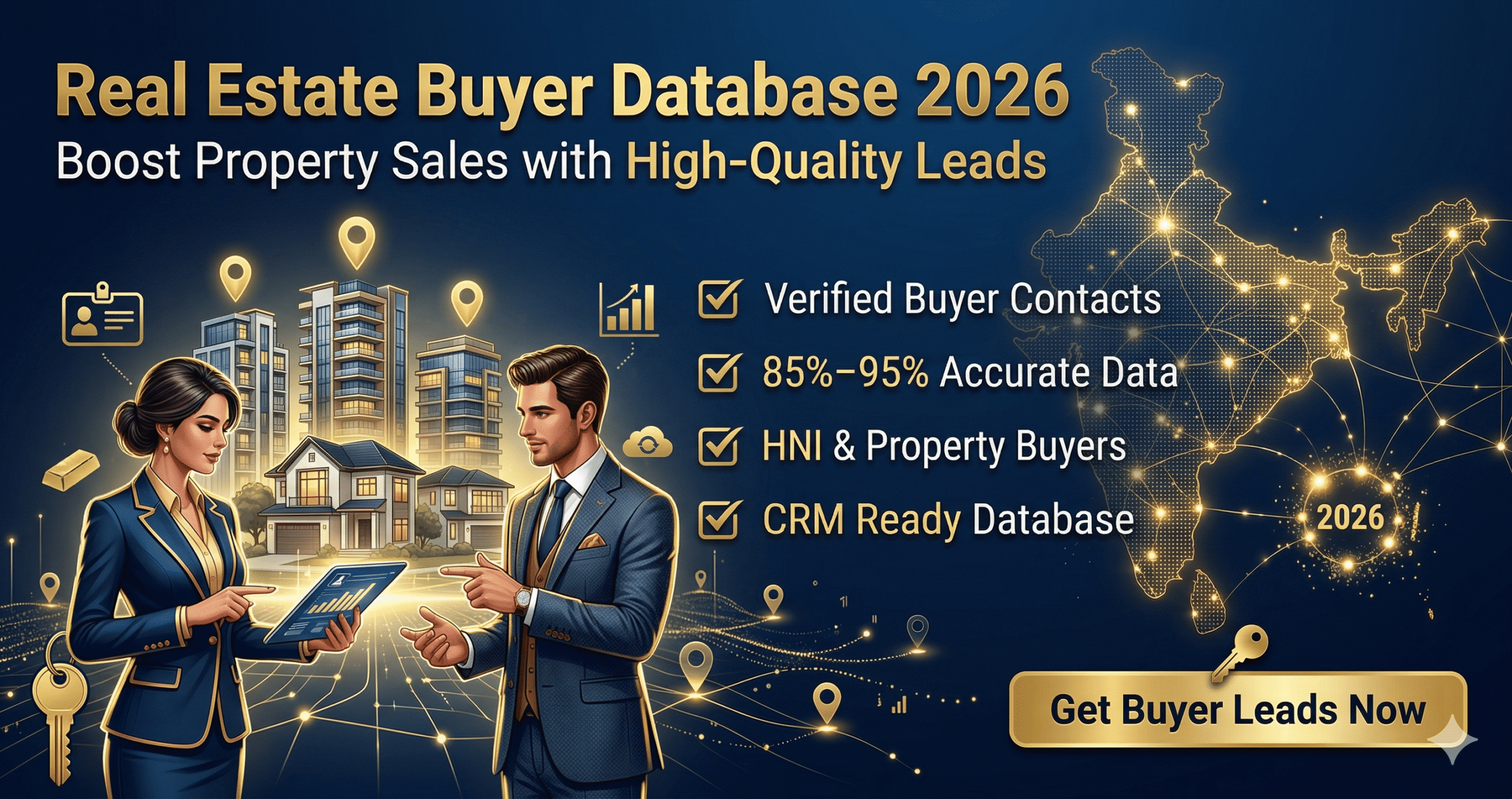
A reliable buyer database should be updated with the latest information, ideally reflecting current market conditions. Accuracy is also critical, with a good database typically offering around 85% to 95% reliability.
It should cover a wide geographic range, especially for agents operating across multiple regions. The format should be easy to use, such as Excel or Google Sheets, allowing seamless integration into CRM systems.
A well-structured database usually includes names, contact details, email addresses, location information, and buyer profiles. This level of detail allows for more personalized and targeted communication.
📈 The Difference It Creates in Business Growth
The impact of using a buyer database becomes clear when compared to traditional methods. Without it, agents rely on limited leads generated through ads or referrals, often resulting in slow and unpredictable growth.
With a buyer database, the scale changes completely. Agents can reach out to hundreds of potential buyers daily, creating a consistent flow of conversations and opportunities. Direct communication increases engagement, and better targeting improves conversion rates.
This shift transforms real estate from a reactive business model into a proactive and scalable one.
⚠️ Common Mistakes to Avoid
Despite its advantages, many agents fail to achieve results due to poor execution. One of the most common mistakes is sending generic or spam-like messages, which can damage credibility and reduce response rates.
Ignoring location relevance is another issue, as buyers are unlikely to engage with properties that do not match their geographic preferences. Lack of follow-up is also a major drawback, especially in an industry where decisions often take time.
Using outdated or unverified data further reduces effectiveness. Ultimately, success depends not just on having data, but on using it strategically and thoughtfully.
🔮 The Future of Real Estate Marketing
Real estate marketing is evolving rapidly in 2026. Technologies such as AI-driven targeting are helping agents understand buyer behavior more accurately. WhatsApp automation tools are enabling large-scale communication without losing personalization.
At the same time, personalized property recommendations are improving the overall buyer experience. Agents who adopt a data-driven approach are gaining a significant competitive advantage.
The combination of buyer databases and modern tools is creating a more efficient, scalable, and predictable sales ecosystem.
🧾 Final Thoughts
In today’s competitive landscape, relying solely on ads is no longer enough to grow a real estate business. Agents need direct access to buyers, faster communication methods, and scalable lead generation strategies.
A buyer database provides all of these advantages practically and effectively. When used correctly, it becomes more than just a marketing tool—it becomes a growth engine that drives consistent results and long-term success.
🚀 Ready to Close More Deals?
Stop chasing leads — start reaching them directly.
👉 Get Verified All India Database from IndiaDatabase.net